
By Andrew Schilling
The Odyssey: Through the Eyes of a Greek Freak
August 5th, 2026
When I was a student at Regis High School in New York, I studied Ancient Greek. And along with the arcane grammar, odd tenses (the aorist!), and weird moods (the optative!) of the language, my class studied the details of Homer’s epics, including The Odyssey in its original Greek dactylic hexameter form.
I didn’t care much for Homer’s Iliad, with its martial focus, bloody battle scenes and self-absorbed heroes. But The Odyssey! That contained timeless stories of travel, heroism, love, homesickness and unequal battles against the gods, the elements, and mythical one-eyed monsters.
As a kid, I first followed the traces of Odysseus through a wonderful National Geographic volume, Greece and Rome: Builders of Our World. My favorite article was penned by a retired British sea captain, who retraced the route of Odysseus through the Mediterranean, with stops and modern-day photos in Sicily, Stromboli and, ultimately, Ithaca, the home of the peripatetic hero.
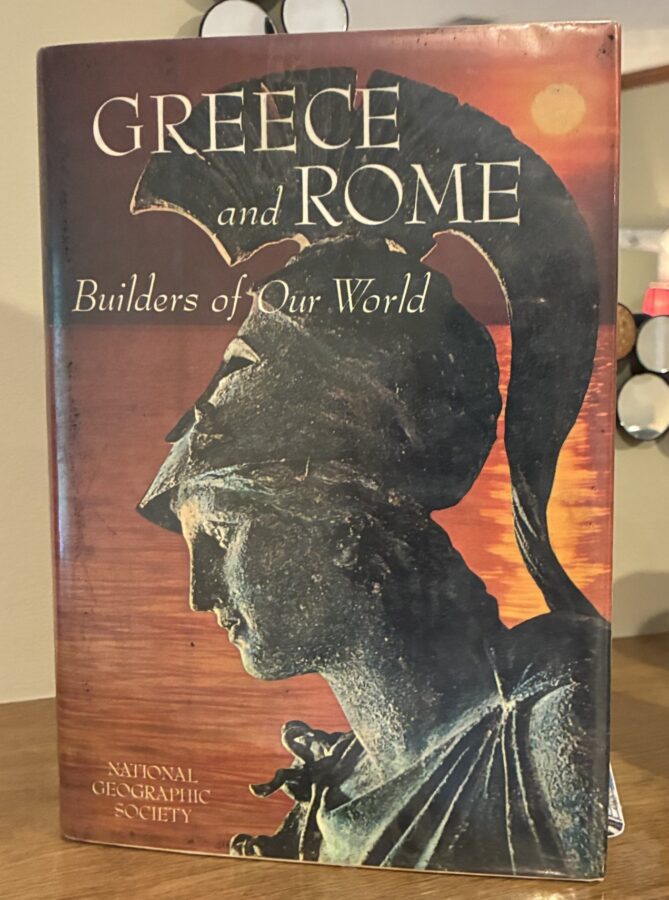
Andrew’s copy of “Greece and Rome: Builders of Our World.”
Later, as a young naval officer, I was able to follow in the wake of Odysseus whenever possible during deployments to the Mediterranean. The Strait of Messina is reputedly where Odysseus and his men encountered Scylla and Charybdis, the first a six-headed, man-eating monster and the latter a sea monster that appeared as a whirlpool that could take down an entire ship. And today, on the neighboring shore of Calabria, you’ll find the town of Scilla, named for the mythical Scylla of The Odyssey, across from Sicily, home of the deadly whirlpool Charybdis (Cariddi). As my destroyer made its passage through the Strait, the waters indeed swirled into whirling and wild currents, which easily could have given rise to the myth of a voracious sea monster below, sucking hapless sailors to their fate.
I recall drawing on my knowledge of The Odyssey to keep sailors awake on a dark, boring midwatch, entertaining them with the exploits of Odysseus – tied to the mast so he could hear the alluring but deadly song of the Sirens, or held captive for seven years by the seductress Calypso. More than 2,500 years later, the tales of The Odyssey still held an audience captive – even at 2 a.m. on the darkened bridge of a Navy destroyer.
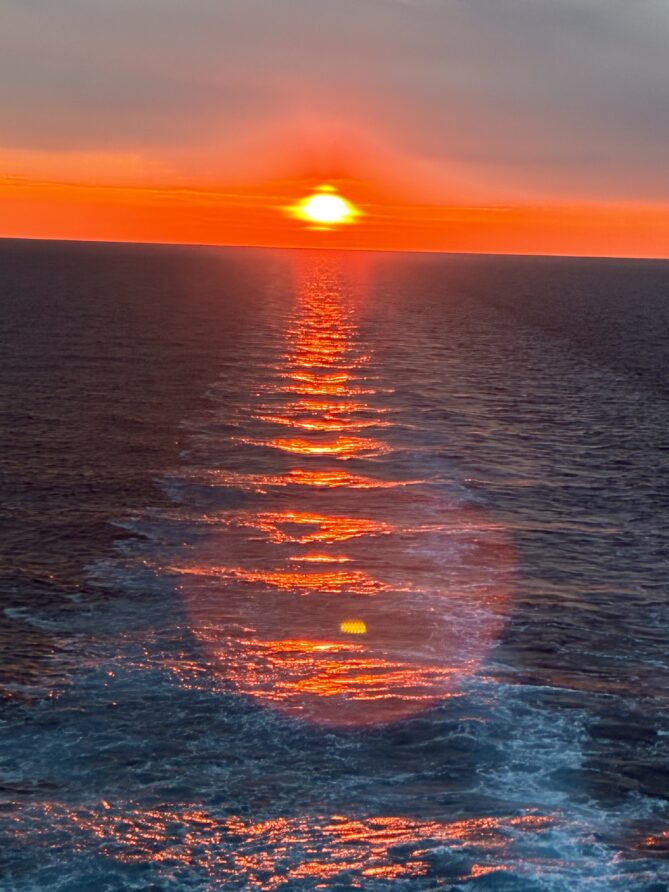
Sunset over the Adriatic Sea.
So, when Christopher Nolan’s epic interpretation of The Odyssey was released in July, I made sure to see the film on its opening weekend. And it is truly an epic – shot in IMAX with wonderful cinematography, remarkable action scenes – with a minimum of CGI-generated stuff here! – and a cast of actors who excel in their roles. It’s truly three hours of non-stop, gripping action, and a re-telling of The Odyssey that is updated for modern tastes, while retaining much of the original beauty that Homer’s bards related.
Nevertheless, the Odysseus portrayed by Matt Damon is different from the man the Muse sings of in the opening lines of The Odyssey (“much traveled, long suffering after sacking the high citadel of Troy”). Matt Damon’s Odysseus is racked by guilt, to the point of amnesia, as he recalls and then suppresses some of his worst (mis)deeds, enabled through his legendary intellect and wiles: The ruse of the Trojan Horse which led to the sacking and pillage of Troy. Misleading his men to follow him to their doom. Fooling the cyclops and blinding him to enable his escape from the one-eyed monster’s cave. Such abuses of his brilliant mind and intellect earned guileful Odysseus a place in the Eighth Circle of Hell, according to Dante.
My sense is that director Christopher Nolan attempts to recognize and attenuate the dark side of Odysseus, by presenting him as penitent and rueful throughout the film, to make up for a life full of deceit and guile. I won’t spoil the ending – but it’s a departure from the actual ending of The Odyssey.
This different portrayal of Odysseus strays from the remarkable and captivating story of the actual text, where the wily hero Odysseus comes across as human . . . emotional . . . and a crybaby! In fact, Homeric scholars have counted some 16 times throughout The Odyssey where Odysseus breaks down in tears – 17, by my count, if you include Odysseus wiping a tear from his cheek as he encounters his loyal dog, Argos, when he arrives home after 20 years. More about that later.
In Homer’s text, Odysseus spends seven years on Calypso’s island, staring out at the sea, longing and weeping for his wife and his home on Ithaca. The gods finally have enough of his bawling and dispatch Hermes (aka Mercury – you know, the messenger of the gods with wings on his helmet) to order Calypso to set Odysseus free and send him back home. And so, she does.
Nolan omits the very heart of The Odyssey, where Odysseus relates his ten years of travels, travails and shipwrecks to the Phaeacians, who have rescued him (it is said) on the shores of modern-day Corfu after his latest shipwreck. In Homer’s telling, the King of the Phaeacians observes that Odysseus is sobbing pitifully as he listens to the after-dinner entertainment – a minstrel recounting the sack of Troy and the heroic exploits of Odysseus. The king asks Odysseus to relate what is bothering him, and the hero pours out the details of the ten years of wandering, storms, shipwrecks and death that he has endured. These include the famous episodes of the Lotus Eaters; Circe; Aeolus, the king of the winds; Calypso; and the herd of Apollo’s cattle – in short, the very heart of The Odyssey that makes it such an epic tale.
Besides the emotional, homesick Odysseus, the original text shows a man who is bold, selfish and at times afflicted by the very arrogance, hubris, that was most despised by the Greeks under “the rule of Zeus” – that brought down the cyclops Polyphemus, along with the evil suitors encamped in the palace at Ithaca.
In this regard, Nolan’s retelling of the cyclops episode omits the brilliant guile of Odysseus, his clever play on words, and an example of the hubris of Odysseus himself: When Polyphemus demands to know the name of his unknown guest (an act of hubris that Homer termed “the MOST hubris”), Odysseus cleverly replies, “Nobody.” Later, after Polyphemus has been blinded by Odysseus and his men and is screaming for help, the neighboring cyclopes gather outside the cave to ask who is bothering Polyphemus. “Nobody!” is the reply – and so the cyclopes all go away. But the acts of hubris do not end there; safely out of range of Polyphemus (and the boulders he hurls at the departing Greeks ships), Odysseus can’t resist rubbing things in, shouting: “No, it wasn’t ‘Nobody’ who blinded you – it was I, Odysseus, King of Ithaca!” Ah, such hubris! And a deliberate insult to Poseidon, the father of Polyphemus, who avenges his blinded son by unleashing a violent storm that destroys the Greek ships and strands Odysseus.
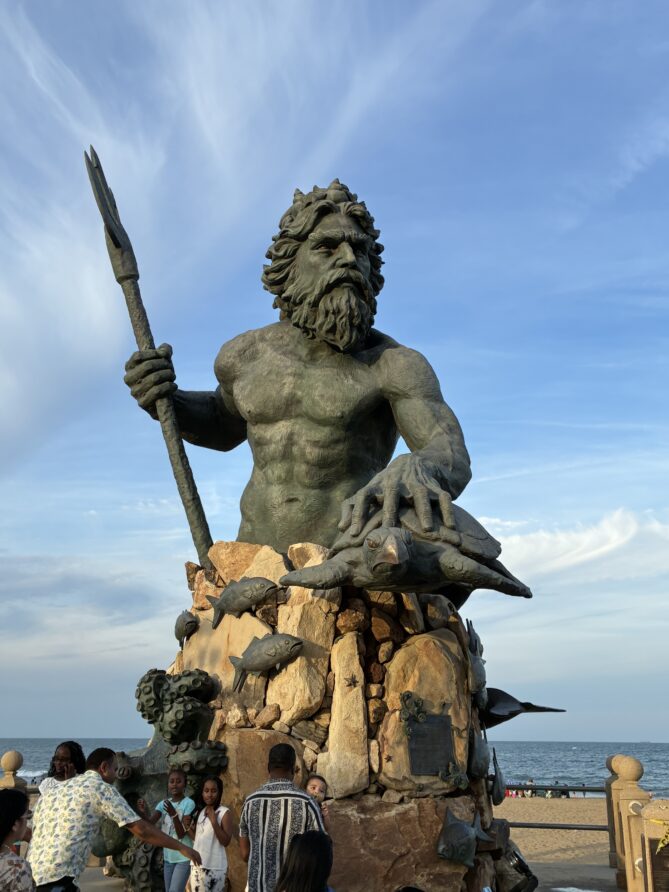
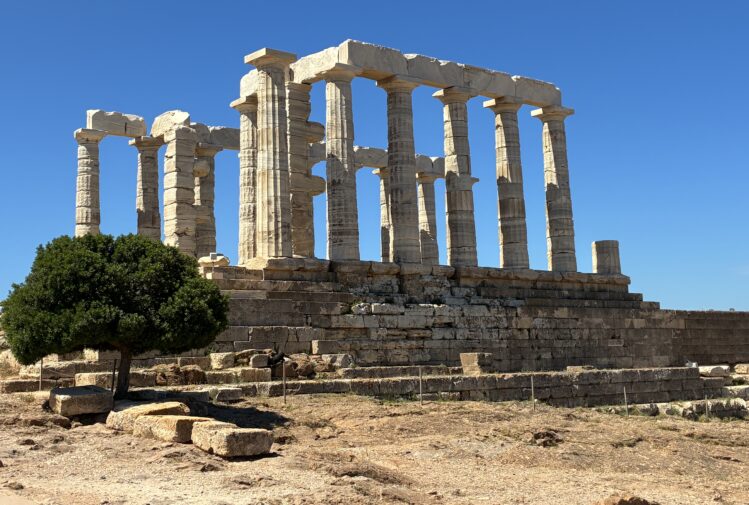
The Neptune statue, Poseidon, at Virginia Beach
For me, the most heart-breaking episode of The Odyssey comes during the hero’s homecoming. Homer relates that Odysseus returned home to Ithaca disguised as a beggar, revealing himself to no one. Odysseus knew that his maintaining his anonymity would be key to gaining the upper hand over the many suitors in his palace. However, Argos, the loyal dog of Odysseus, recognizes his master on his return after 20 years, and perks up his ears in recognition. Tragically, Odysseus cannot betray that he recognizes his beloved dog lest he reveal his identity. So, he turns and wipes away a tear so that no one can see the connection. And at that moment, the dog laid down his head, and “death came and darkened the eyes of Argos, who had seen Odysseus again after twenty years.”
Nolan’s film presents the Argos episode – and others – in a slightly different way from Homer (perhaps not in the exact way that Homer’s bards would relate, but in equally epic fashion). The film is a contemporary tribute to the Greek epic and the exploits of the legendary hero Odysseus, filled with dramatic tension and the stuff that makes tragedy great – murder, revenge, and greed.
At KVNO we spend a lot of time listening closely to the way music shapes a story, so it’s always fascinating to hear how a filmmaker approaches a score, especially when that approach breaks from tradition. Director Christopher Nolan chose to stray from the traditional epic soundtrack for his Odyssey, asking Ludwig Göransson to refrain from using a full orchestra. Instead, the composer chooses to use a variety of period instruments, such as gongs and shepherd flutes, which impart a sound that is eerie, driving and even POUNDING. The approach is well suited to the many action scenes, from the sacking of Troy to the extended battle against the suitors. The effect is a bit strange for more tender scenes involving Calypso or Penelope. You can listen to the soundtrack here.
The Odyssey is a film worth seeing, highly recommended, and likely to (re)awaken your interest in the timeless legends from Greek mythology!

