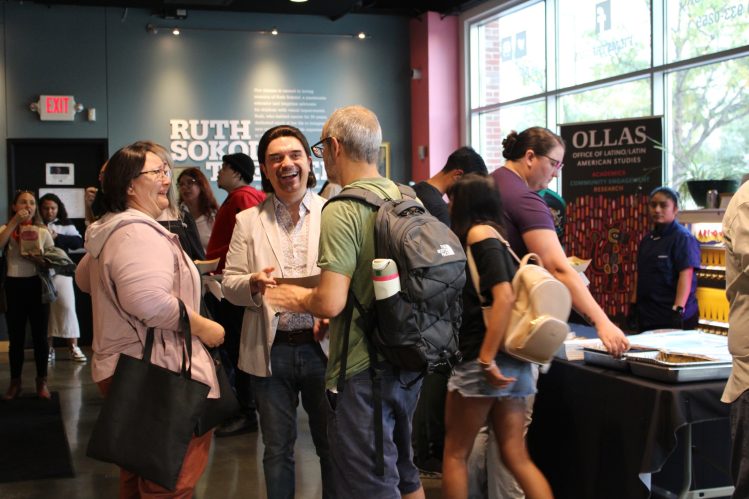
Guests mingle before the closing film of the Cinemateca Film Festival, where cinema meets conversation and culture.

By Gabriel Escalera
Cinemateca’s Festival Brings Latin American Cinema to Omaha
September 22nd, 2025
In downtown Omaha’s Ruth Sokoloff Theater, audiences gather every two years for an experience they won’t find at typical movie theaters: films with Spanish dialogue and subtitles that tell stories from across Latin America and Spain, followed by community conversations that bridge cultural divides.
Cinemateca, now in its ninth edition since 2008, brings Latino and Latin American cinema to Nebraska audiences seeking diverse storytelling beyond Hollywood’s reach. The festival launched last Monday with the Mexican film “Güeros,” with three more screenings scheduled through early October.
“Cinemateca is an attempt to show films from Spain, Latin America, and Latino communities,” said Dr. Eugenio DiStefano, co-chair of the Cinemateca Film Committee and professor at the University of Nebraska at Omaha. “The attempt is to kind of have a space where people can come together and see films in Omaha that are normally not seen or experienced in theaters.”
DiStefano and fellow UNO professor Dr. Stephen Torres spend months curating each festival’s lineup, starting with over 100 films before debating themes, weighing artistic value, and considering community impact. Their selection process reflects a commitment to showcasing the breadth of Latin American cinema while serving Nebraska’s Latino community.
This year’s remaining films highlight that diversity: “Beatriz at Dinner,” “Neighboring Sounds” from Brazil, and Argentina’s “Wild Tales.” Each screening begins at 6:30 p.m. at the Ruth Sokoloff Theater and includes cultural elements designed to immerse audiences in the filmmaking countries’ traditions.
“One of the most appealing things about this film series is that people can come, and there’s always food or an appetizer, something that is typical from the country of origin of the film that we’re about to watch to get a taste, quite literally, of the culture,” Torres said. “Then we watch the film, and after the film, there’s a forum with an expert who can talk about the film’s importance, meaning, and its relevance.”
The post-screening discussions have become a festival hallmark, creating space for audiences to process what they’ve seen while learning from scholars and community leaders. These conversations often extend beyond cinema into broader cultural and social themes, fulfilling the organizers’ vision of film as a catalyst for community dialogue.
For Torres and DiStefano, Cinemateca represents more than entertainment. In a community where Latino culture, while significant, often lacks visibility in mainstream venues, the festival creates intentional space for underrepresented voices.
“We feel that it’s important to recognize and validate Latino and Latin American and Spanish culture in the community,” Torres said. “It’s often not as visible or salient as it could be. This really is an opportunity to celebrate some of the cultural accomplishments of a broad segment of the population.”
The festival alternates biennially with the Latino Art Exhibit, ensuring consistent programming from UNO’s Office of Latino Latin American Studies. This rotation allows organizers time for thorough preparation while maintaining regular cultural programming for the community.
The timing feels particularly significant to both professors, who see cinema as a bridge-builder in an era of increasing division. The festival attracts diverse audiences — different ages, backgrounds and perspectives — united by curiosity about stories beyond typical American cinema.
“I think it’s more important now than ever,” DiStefano said. “I think we need spaces where we can kind of come together and discuss. And I think coming to a theater, watching a movie, and sitting with other people is really important in the current climate. Any chance we have to be together is something for the good.”
Tickets typically sell out quickly, and advance purchase is recommended. The next screening, “Beatriz at Dinner,” is scheduled for Thursday, followed by “Neighboring Sounds” on September 30 and “Wild Tales” on October 7.
All films include English subtitles, welcoming audiences regardless of Spanish proficiency to experience stories that might otherwise never reach Nebraska screens. The festival’s accessibility reflects its broader mission of creating inclusive cultural experiences that serve both Latino communities and curious filmgoers seeking international perspectives.
Since its inception in 2008, Cinemateca has established itself as a cornerstone of Omaha’s cultural calendar, providing consistent access to Latin American cinema while fostering cross-cultural understanding through the shared experience of storytelling.
For more information about Cinemateca and upcoming screenings, contact the University of Nebraska at Omaha’s Office of Latino Latin American Studies.

