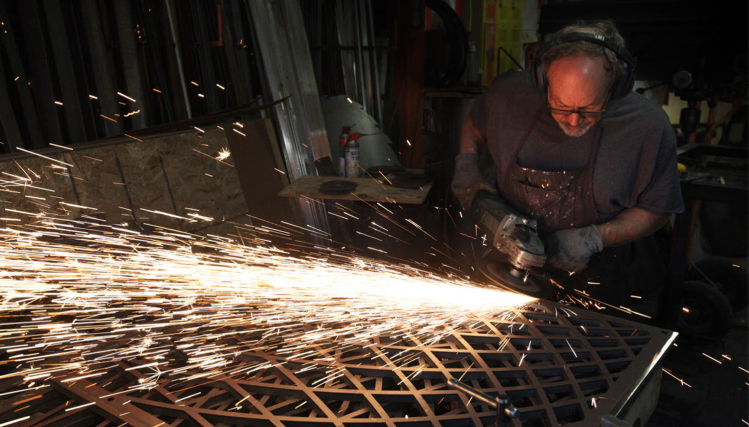
Inside the Hot Shops Art Center, an artist shapes metal with a grinder, capturing the energy and creativity that define Omaha’s artistic hub.

By Gabriel Escalera
Hot Shops Art Center, Where Artists Find Community and Space to Create
January 27th, 2026
Just north of downtown Omaha, there is a building where creativity is not hidden behind gallery walls or reserved for special events. At Hot Shops Art Center, art is made in real time, every day, by artists who treat their craft as both passion and profession.
For twenty five years, Hot Shops has been a cornerstone of Omaha’s creative community. It is a place where artists gather to work, experiment, and connect, helping shape what it means to be a working artist in the heartland. Inside its walls, more than one hundred artists create across dozens of disciplines, from painting and sculpture to glass, ceramics, and mixed media.
Painter Jill Rizzo has been part of Hot Shops since the very beginning. Working in oils, acrylics, and mixed media, her art often uses animals and landscapes to explore the human condition. She shares the building with artists who work in vastly different mediums, yet all are united by the same commitment to showing up and creating.
What makes Hot Shops unique, Rizzo says, is not just the number of artists, but the structure that supports them. As a nonprofit organization, Hot Shops requires its artists to be present and actively working in their studios for at least twenty hours a week. That accountability creates an environment where creativity is not an abstract idea, but a daily practice.
The building itself has an equally intentional story. Originally owned by five artists, Hot Shops eventually transitioned into a nonprofit to ensure its long term survival. The goal was simple but urgent, to preserve affordable studio space in a city where rising development costs make it increasingly difficult for artists to find room to work.
That access to space has become one of Hot Shops’ most important contributions to Omaha’s arts scene. Affordable studios allow artists to focus on their work rather than constantly worrying about displacement, a growing concern as properties are bought and converted for other uses.
While Hot Shops is a working space first, it is also deeply connected to the public. The building is open seven days a week, inviting visitors to walk the halls, step into studios, and witness the creative process as it unfolds.
Josie Langbin, the education and program manager, sees this openness as essential. An acrylic painter focused on portraiture and lived experience, Langbin came to Hot Shops six years ago after spending fourteen years teaching in public schools. Her role now bridges art making and education, helping design programs that welcome people of all ages into the creative process.
Visitors, she explains, get to see what is usually hidden. They see unfinished work, discarded ideas, and moments of uncertainty alongside breakthroughs and final pieces. At Hot Shops, art is not presented as a polished conclusion, but as a journey filled with trial, error, and discovery.
Education plays a central role in that mission. Hot Shops offers classes for all ages, runs youth programs, and recently launched a new high school internship. Students from the Allie Webb Center work alongside professional artists, learning not just techniques, but what it means to sustain a creative life.
On any given day, children wander through the building curious and leave with paint on their hands. Adults stop in expecting to browse and instead find themselves in conversation with an artist mid process. In those moments, Hot Shops shows the community that art is not just a hobby or decoration.
It is work. It is communication. And it is an essential part of what makes us human.
More information is available at hotshopsartcenter.org.

