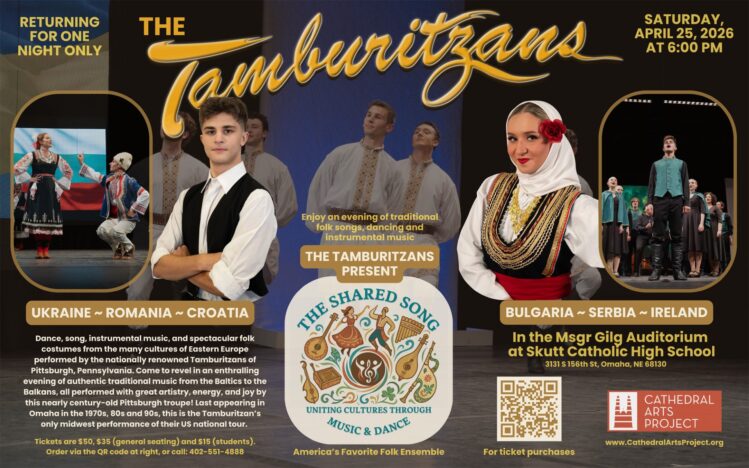
A vibrant ensemble of dancers and musicians brings global traditions to life in The Tamburitzans.

By Gabriel Escalera
A World of Music and Dance Returns to Omaha
April 7th, 2026
Some things in a city come and go. Others leave a mark deep enough that people still talk about them decades later. The return of the Duquesne University Tamburitzans is one of those moments for Omaha, a revival of a cultural experience that has been woven into the city’s artistic memory for nearly 70 years.
The effort to bring them back comes from the Cathedral Arts Project, an organization that has quietly shaped Omaha’s cultural life for more than four decades. Rooted in the idea that gathering spaces should also inspire through art, the organization continues to build bridges between communities through performance and storytelling.
For Bob Weil, President-elect of the Cathedral Arts Project’s Board of Directors, that mission felt immediately familiar when he arrived in Omaha in 2021. After retiring and relocating to be closer to family, he discovered a city rich in culture and an opportunity to reconnect with a beloved tradition.
The Tamburitzans, founded in 1937, are a dynamic ensemble of dancers, musicians, and singers who celebrate the folk traditions of Eastern Europe. Their performances blend intricate choreography, live music, and vibrant costumes into a sweeping cultural experience. Over the decades, they have represented a wide range of countries and regions, bringing global traditions to American stages.
Their history in Omaha stretches back to 1959, when they were first invited by the Croatian Cultural Society. That initial performance filled a modest high school auditorium. But the group’s popularity grew quickly. By the early 1990s, they were drawing crowds of nearly 1,800 people to the Orpheum Theater, a testament to their lasting impact.
Weil knows firsthand how powerful that experience can be. Having hosted the Tamburitzans in Southern California for years, he recalls how even hesitant audience members, especially younger ones, leave the performance energized and inspired.
This season’s program promises to be just as expansive. While rooted in Eastern European traditions, the performance stretches beyond, incorporating influences that reach as far as Ireland. The result is a vibrant evening of music, movement, and storytelling that invites audiences to travel the world without leaving their seats.
For Weil, that idea is central. Not everyone has the opportunity to travel internationally, he says. But performances like this offer a window into other cultures, a chance to experience the richness of global traditions in a single evening.
The return of the Tamburitzans is just one part of a broader vision for the Cathedral Arts Project. Upcoming programming includes a rare Spanish colonial art exhibition this spring, the global music event La Folia Global in July, and a series of poetry art walks throughout May and June.
Together, these events reflect a commitment to expanding access to the arts across Omaha, creating space for performances and exhibitions that connect communities and celebrate cultural diversity.
For more information, visit cathedralartsproject.org.

