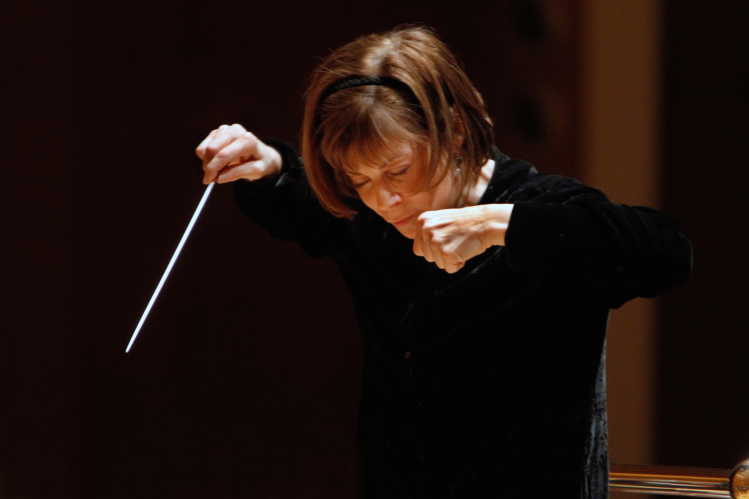
JoAnn Falletta, newly appointed Principal Guest Conductor and Artistic Advisor for the Omaha Symphony, leads the orchestra in rehearsal.

By Coleen Cook
Glass Ceiling Breaker JoAnn Falletta Brings Grammy-Winning Leadership to Omaha Symphony (PT-1)
September 23rd, 2025
When JoAnn Falletta steps onto the podium at Holland Performing Arts Center this weekend, she brings more than three decades of barrier-breaking leadership to the Omaha Symphony as its new Principal Guest Conductor and Artistic Advisor.
The Juilliard graduate and Grammy winner made history in 1999 when she became Music Director of the Buffalo Philharmonic Orchestra, becoming the first woman to lead a major American orchestra. Now she’s helping guide the Omaha Symphony through its artistic transition while continuing her groundbreaking career.
Falletta’s path to the podium began with an unexpected seventh birthday gift that would change her life forever.
“Well, it was very long ago, so I can pinpoint one very, very important time, and that was when I was 7 years old, and I was on my 7th birthday party, and my father gave me a classical guitar,” Falletta recalled. “Very big surprise for me and I fell in love with that guitar, and I think from that day on, music was, like, the guiding force in my life. I just loved it.”
That childhood love of music grew from guitar into an obsession with the symphony orchestra, culminating in a transformative experience that would define her career path.
“I remember when I was 11 years old, I went to a concert at Carnegie Hall with my parents and my sister, and I heard the orchestra… I heard an orchestra for the first time. I mean, alive, in Carnegie Hall,” she said. “Leopold Stokowski was conducting the American Symphony. And that was it for me. I heard Beethoven 6, I remember the piece very clearly! And I just thought there was no better place that anybody could be except in the middle of that sound and those people. So, that was it.”
That moment at Carnegie Hall set Falletta on a course that would see her break through barriers in a field traditionally dominated by men. Her persistence and love for music carried her through Juilliard and into professional conducting at a time when women in the field were extraordinarily rare.
“Well, I think I was very lucky. The door was just creaking open for women in all professions, and it wasn’t only music,” Falletta reflected. “And I was very lucky because I… I never… I just persisted because I loved music. I wasn’t trying to make any statement. I just loved music. I was the only woman in my class, and it was still very, very rare, but …I never felt deterred.”
Among her most influential mentors was Leonard Bernstein, who taught master classes at Juilliard. His lessons went far beyond technical conducting skills, focusing instead on the emotional and dramatic heart of music.
“He would come to Juilliard occasionally and teach us, because he lived in New York, and it was always a big deal. And of course, we were trying so hard to be exactly correct, and place our beats in the right place, and make sure we were showing our gestures,” she remembered.
Bernstein challenged his students to think beyond mechanics. During a study of Carmen, he told them: “You’re in the middle of a bullring in Seville. And it’s 110 degrees, and you can smell the blood of the bull in the bullring. You could hear the people screaming at you. That’s where you are. He said it’s all about the emotion and the drama of what the composer is writing. It’s not about being careful about how you conduct. He was so right.”
That philosophy has guided Falletta throughout her distinguished career, which includes multiple Grammy Awards and recognition by Gramophone Magazine as one of the “Fifty Great Conductors.” She has conducted over 1,600 orchestral works by more than 600 composers, championing both traditional repertoire and contemporary works.
As Music Director of the Buffalo Philharmonic for 25 years, Falletta has built a reputation for artistic excellence and innovative programming. Her Grammy-winning recordings and international guest conducting appearances have established her as one of the leading conductors of her generation.
Now, in her role with the Omaha Symphony, Falletta brings that wealth of experience to help navigate the orchestra through its current transition period. As Principal Guest Conductor and Artistic Advisor, she will provide artistic leadership while the organization searches for its next permanent music director.
The appointment represents both continuity and change for the Omaha Symphony, combining Falletta’s proven leadership abilities with her fresh perspective on orchestral programming and development. Her experience guiding major orchestras through artistic growth makes her uniquely qualified to shepherd the Omaha Symphony’s next chapter.
This weekend’s opening concert will give Omaha audiences their first taste of Falletta’s dynamic conducting style and musical philosophy. For a conductor who found her calling hearing Beethoven at age 11, the opportunity to share that transformative power of orchestral music with new audiences continues to drive her passion.
Falletta’s journey from a seven-year-old with a guitar to one of America’s most respected conductors illustrates both personal determination and the gradual opening of opportunities for women in classical music. Her success has paved the way for future generations while proving that artistic excellence transcends traditional barriers.
The Omaha Symphony’s partnership with Falletta signals its commitment to maintaining the highest artistic standards during its leadership transition, ensuring audiences continue to experience world-class performances while the organization charts its future course.
Her appointment as Principal Guest Conductor and Artistic Advisor represents more than a temporary solution – it’s an investment in artistic leadership that could shape the orchestra’s direction for years to come. With Falletta’s guidance, the Omaha Symphony enters its next phase with both stability and the promise of continued artistic growth.

