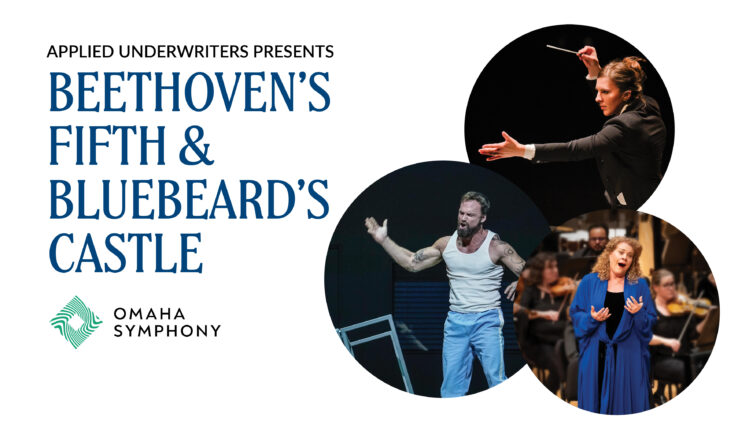
A conductor guides the Omaha Symphony as two vocalists bring Bluebeard’s Castle to life in this Opera Omaha co-production.

By Gabriel Escalera
When Two Become One
April 21st, 2026
Opera Omaha and the Omaha Symphony have shared stages for decades. Now, for two nights only, they share something rarer — a single, unified vision for Bartók’s haunting masterpiece.
There are collaborations of convenience, and then there are collaborations of conviction. What Opera Omaha and the Omaha Symphony are bringing to the Holland Performing Arts Center this April 24th and 25th belongs firmly in the second category.
The two organizations have woven their histories together for longer than most Omaha audiences can trace. Symphony musicians have filled the pit at the Orpheum for Opera Omaha productions for decades. Their audiences overlap, their musicians know each other by first name, and their artistic visions have, over time, grown toward one another like two trees in the same yard. But a genuine co-production — designed from scratch, built for a shared stage, conceived to feature both ensembles in full — is something rarer. And rarer still when it centers on Béla Bartók’s only opera, Bluebeard’s Castle.
“We wanted to know if there was repertoire that we could essentially set around the orchestra on the Holland stage and feature the best of both companies.”
— Danny Meyer, VP of Artistic Administration, Omaha Symphony
The idea of returning to Bartók had been percolating for a while. Opera Omaha had presented the piece in concert form roughly thirteen years ago at the Orpheum with the American bass Sam Ramey. But the Orpheum, beloved as it is, has a pit problem: the Bartók orchestra is simply too large for it. Too large, in fact, for almost any existing pit in the city. The Holland, with its open stage and architectural adaptability, offered a different kind of possibility.
Josh Quinn, Head of Music and Chorus Director at Opera Omaha, seized on it. By mounting the production at the Holland, the two companies could do something they couldn’t do anywhere else: place the full symphony on stage, surround it with singers of international caliber, and build an immersive world around all of it — projections, shadow play, atmospheric design — that would make the castle feel real from the first note to the last.
The cast assembled for this production is, by any measure, exceptional. Ryan McKinney takes on the role of Bluebeard — a character whose terrifying power lives as much in quiet restraint as in the enormous sound he commands. Opposite him is the mezzo-soprano Michelle DeYoung as Judith, the new wife who enters the castle determined to bring light into its darkness, door by door, until the truth of what her husband has hidden becomes impossible to ignore.
“Her voice — it’s not only her voice, but her storytelling through text and the color she brings.”
— Josh Quinn, Head of Music & Chorus Director, Opera Omaha
Conducting the evening is Lydia Yankovskaya, whose international reputation is built in large part on exactly this kind of Slavic repertoire. She has conducted Bluebeard’s Castle across the world and brings to it both authority and a deep feel for the score’s particular kind of darkness — the kind that doesn’t announce itself loudly, but gathers in the corners of every phrase.
Yankovskaya has worked with the Omaha Symphony before. In April 2023 she stepped in to lead a masterworks program built almost entirely of French music — a demanding substitution on short notice that left a lasting impression on the musicians who played under her. “She made it just breathtakingly gorgeous to work through,” Meyer recalled. The prospect of what she might do with Bartók has him, in his own words, already reaching for his tissues.
The evening is designed in two halves, and the programming is deliberate. The first half belongs to Beethoven’s Fifth Symphony — perhaps the most famous piece of music ever written, built on four notes that seem to live in the cultural bloodstream whether or not you’ve ever set foot in a concert hall. Meyer describes it as the journey from darkness into light. The second half, the Bartók, is the journey back — a slower, more intimate, more irrevocable descent into shadow.
For audiences who have never attended an opera before, Quinn is emphatic: this is an ideal starting point. The score does an extraordinary amount of narrative work on its own. Projection designer David Murakami — whose career has been built primarily in opera — will layer shadow imagery and atmospheric visual design throughout the Bartók to deepen the immersion without replacing what the music already creates. Costumes and a traditional set are absent, but their absence, Quinn argues, will not be felt.
“Bartók did ninety-nine percent of the work in his score. You can see and hear everything that is being sung about in the music.”
— Josh Quinn
What the Holland offers, above all else, is the capacity to become something other than itself. Its warm wood and open space — familiar to so many Omaha concertgoers — will be transformed, for these two evenings, into something far darker and more enclosed. The familiarity of the venue becomes, paradoxically, part of the effect: a space you know made strange, a room you thought you understood suddenly full of closed doors.
Two performances. Two chances to witness what happens when two of Omaha’s finest arts organizations stop working alongside each other and start, for once, working as one.

