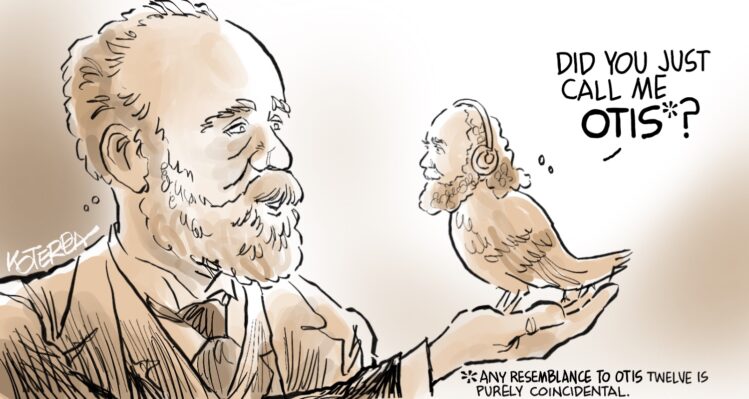

By Coleen Cook
Antonin Dvorak: A Composer’s Unlikely Pet Passion
April 15th, 2026
I’ve been reading up lately on “Fur Baby” science. It seems scientists have found a neurological reason for why we love our pets. Scientists say a pet’s face resembles a child’s. Subsequently, the face of a pet triggers a neurological response in us, similar to that of a child’s face, and triggers a strong maternal or nurturing instinct.
This explains why spoiled cats ruled the lives of French composers Maurice Ravel and Claude Debussy, knocking over ink wells and leaving paw prints on famous music manuscripts. This explains why Sir Edward Elgar treated his three dogs like his children, taking them everywhere, and wishing them goodnight on a radio broadcast. In fact there are many famous classical composers who were avid dog lovers. Sergei Rachmaninoff owned a big dog named Levko, who provided companionship during the composer’s severe depression and creative crisis around 1899. Beethoven had several dogs; the most famous one was named Guter Freund ( meaning “Good Friend” in German). That says it all. Mozart had a dog named Bimperl but was more famous for his affection for a pet starling. That doesn’t quite validate the “Fur Baby” science. But Mozart’s own journals explain that he bought the bird because it could whistle the first five measures of the finale of his 17th Piano Concerto. There’s no shortage of composers who found musical inspiration in singing birds.
A Composer’s Love for Pigeons
But “Fur Baby” science offers no explanation for the devotion of one composer to his pets. Czech composer Antonin Dvořák’s affection centered completely on pigeons. Not just one pigeon, but dozens. For Antonin Dvořák, one could never have too many pigeons.
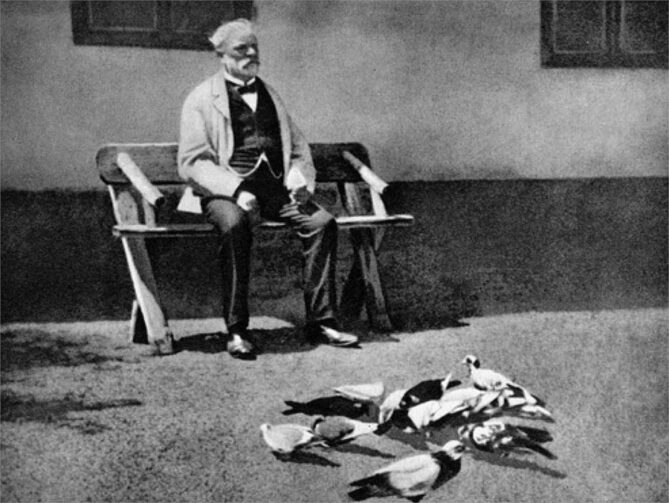
Dvořák and his pigeons
While living in Bohemia, Antonín devoted himself passionately to breeding pigeons. This well-known classical composer displayed a deep affection for small animals that some consider to be bothdirty and a nuisance. This flies in the face (no pun intended) of “Fur Baby science.” Unlike professional breeders, Dvořák did not focus on a specific pigeon breed for the purpose of selling. He filled his pigeon loft with as many different species as possible. He considered them all his pets. His fascination with pigeons included being involved with every detail of their care. And when he traveled abroad, he corresponded frequently with his housekeeper, sending detailed instructions on how to ensure their well-being. In a letter to his friend Antonín Rus, Dvořák’s passion for pigeons is obvious. He laments to his friend that a certain male bird had left his loft. He speaks in detail about the urgency he feels to replace it right away, describing what kind of a cock he’s looking for, and how happy he would feel if he could get two more!
The more famous Dvořák became, the more his enthusiasm for pigeons became known, even beyond the borders of Bohemia.
During a concert in England, where he had become incredibly famous, Queen Victoria and Prince Albert sent someone to ask Dvořák’s wife Anna about what Dvořák enjoyed the most. Anna truthfully replied that her husband’s greatest love, after his music, was his pigeons. Not long after returning to Bohemia, Dvořák received an unexpected gift: a royal shipment of prestigious English pigeon breeds, compliments of the English royal family.
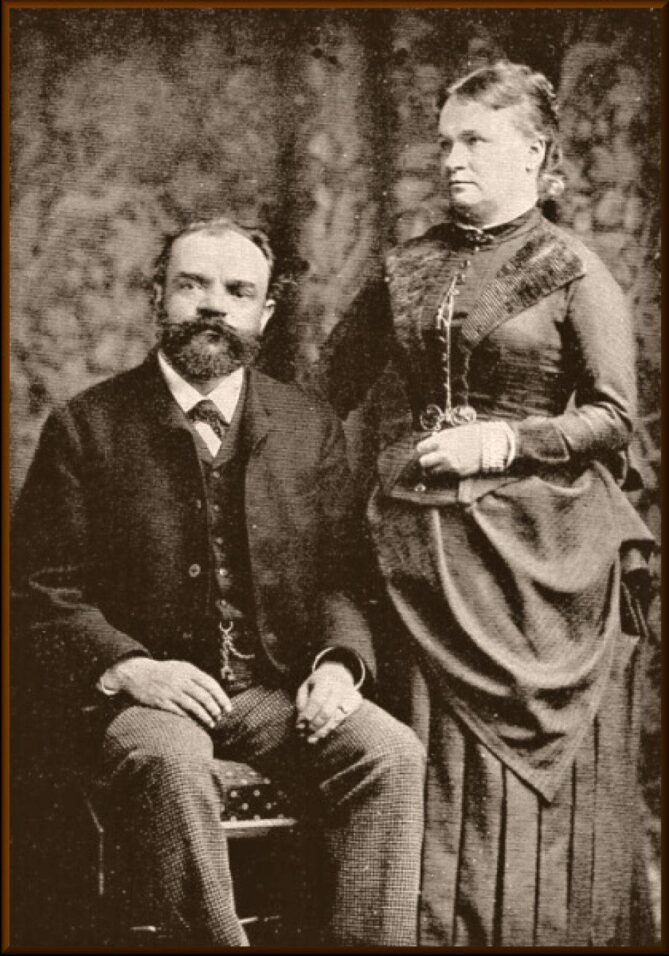
Dvořák, with his wife, Anna.
A Man and His Birds
While living in America for a few years, from 1892 to 1895, while directing the National Conservatory in New York City, Dvořák’s home sickness for his pigeons was apparent in his letters home. Writing often to his housekeeper, he enquired constantly about his birds’ well-being and included meticulous instructions on keeping his little friends healthy and contented. Once or twice a week while in New York City, Dvořák would visit a small zoological garden in Central Park where about two hundred pigeons were kept.
Always homesick for his birds, he turned to nature for comfort in America. In in the summer of 1893, Dvořák took a trip to visit a community of Czech immigrants in Spillville, Iowa. He spent a lot of time walking alongside a stream that ran through Spillville. Inspired by a bird he came across there, he spent about an hour observing it. It was during this “vacation” that he wrote his “American” String Quartet No. 12. While there are no direct quotes from American folk music in the American Quartet, there are quotes from birds. Dvořák included a musical interpretation of the bird’s song in the American Quartet’s 3rd movement and also wrote about the bird encounter in his journal.
After returning to Bohemia from America, the composer was once again reunited with his pet pigeons, especially his favorites. Yes, he had an “inner circle” of eight pigeons that were his particular darlings, each one carefully named. They were Annamae, Cletus, Elmo, Jolene, Loretta, Tex Zachariah—and Otis!

