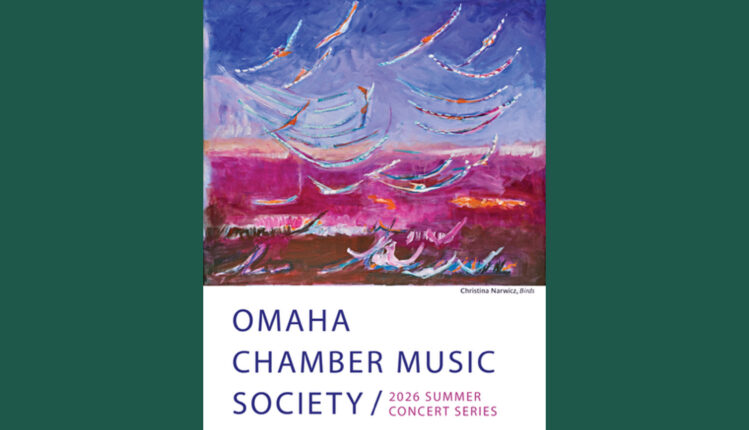
The Omaha Chamber Music Society announces its Summer Concert Series with promotional artwork inspired by open skies, natural landscapes, and the expressive spirit of live chamber music.

By Gabriel Escalera
Omaha Chamber Music Society closes summer series with Baroque Latin America program
June 26th, 2026
Sunday’s concert features composers from Bolivia, Peru, Mexico, and Colombia — and instruments most Omaha audiences have never seen live
The Omaha Chamber Music Society wraps its 2026 Summer Series this Sunday with a program unlike anything the organization has presented in its 26-year history.
Rhythms, Reverence & Revelry from Baroque Latin America draws on sacred and secular compositions from the 17th and early 18th centuries, all by composers native to — or working in — Central and South America. Not a single name on the program is familiar to most classical music listeners, and that, says the concert’s curator, is part of the point.
“This is my area of expertise. This is my love,” said Sarah Craner, the violinist and director who built the program. “It’s kind of great to put together a concert like this because I sort of got to pick all my favorites.”
Craner, who holds a doctorate in historical performance from Indiana University, spent months assembling the repertoire. One piece — a string symphony called La Tempesta del Mar, or “The Storm at Sea” — exists only in the appendix of a scholar’s dissertation. Craner wrote to the researcher and received the parts almost immediately.
The program draws music from Bolivia, Peru, Mexico, and Colombia. Among the highlights is a Salve Regina by José Cascante the First, discovered in a cathedral archive in Bogotá and likely performed publicly for the first time in Omaha.
The ensemble performing the concert reflects the music’s unusual demands. Alongside strings and keyboard, the group includes a theorbo — a long-necked, lute-like instrument common in the Baroque era — and three sackbuts, the Renaissance ancestor of the modern trombone. The percussion section will feature a donkey jawbone, a traditional instrument used across Latin America and Peru, sourced from Craner’s sister’s cattle ranch in Colorado.
Jay [last name], who helped shape this summer’s programming, acknowledged that the repertoire is new territory even for longtime chamber music listeners.
“None of the composers are even remotely familiar to me,” he said, “although some of the music styles are something we’re all familiar with from European Baroque music. This is really a brand new experience for us.”
Much of the music on the program does not follow a fixed structure from beginning to end. The performers are making real-time decisions about order, repetition, and even instrumentation. The theorbo player will improvise everything above the bass line. The percussionist has no written part at all.
Craner says that open, exploratory quality is true to the music’s origins. Many of these composers were teachers as well as performers, and the music served as both a spiritual and pedagogical tool.
The concert begins at 3 p.m. Sunday, June 28, with a pre-concert event at 2:30 p.m. Tickets and information are available at omahachambermusic.org.

